

Why is My Cat So Itchy? Cat Scratch Misery Explained
There is a lot of talk and discussion about dog allergies out there, but what about itching in cats?! Luckily, allergies in cats are much less common than in dogs, but if you have a kitty that you are watching scratch then I know you want to get them some relief. Read on to discover the reasons our feline friends itch.
Reason #1: Fleas!
Many of the underlying reasons for itching in cats are similar to dogs. One of the most common reasons are due to fleas. In fact, did you know that the most common flea to affect both cats and dogs is called Ctenocephalides felis- aka the cat flea. The feline fur is the most attractive to these pests. Do you use flea prevention on your cat year-round? The answer is probably no. A study published in the National Institute of Health revealed that only 38% of the total cat population receives flea and tick prevention, with as few as 18% receiving it year-round. This is likely due to the indoor cat myth: “they don’t go outside so they can’t get fleas.” Here are the reasons why this is a myth:
- Fleas are quick and small.
- They can enter your house as hitchhikers on your clothes or other objects.
- Once inside they quickly find your cat- their source of food.
- They bite your cat and take a blood meal then lay eggs.
- Your cat may feel them and groom until they have eaten them- leaving you to wonder because you never actually see the adult flea- but the damage has been done.
Cats with flea allergy dermatitis react severely to the saliva of the flea. Just one bite can incite an intense itch reaction. Furthermore, the life cycle of the flea has begun. Take a look at this:
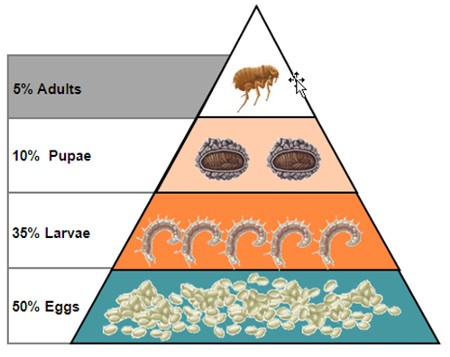
What you see as part of a flea infestation is only 5% of the actual flea population in your home. The other 95% exists as microscopic eggs and maggots. Flea eggs, larvae and pupae can be found in:
- carpets
- furniture upholstery
- bedding
- cracks in floorboards
In fact, 1 female flea can lay 50 eggs a day!!! But wait there’s more…the pupae stage can exist in your home for up to 6 months! They lie in wait and when the time is right, they will find your cat again. So consistent year-round prevention, especially for a flea allergic cat, is critical to keep their itch under control.
When We Control the Fleas- What Else is There?
Next, we can see seasonal allergies cause itching in cats similarly to dogs. See my previous article here all about dog seasonal allergies. The biggest difference for cats is that we don’t have many options for treatments. Putting your cat on a good flea control is our first step for the reasons outlined above. We need to treat any secondary skin infections we see- usually with antibiotics. For the allergy and itch itself we tend to reach for steroids. Thankfully, cat’s tolerate steroids better than our canine counterparts, however there are some underlying conditions where this should be avoided so a thorough exam by a veterinarian is critical before starting medication.
Can Food Make Them Itch?
Food allergies in cats also exist. If we have ruled out fleas and seasonal allergies this is the next place to look. The only real test for a food allergy is an 8-week food trial with a strictly hypoallergenic diet. These diets need to be purchased from your veterinarian. Over the counter “hypoallergenic” diets are not formulated with strict standards and you may see poor response to these foods. The good news if it is a food allergy is that we can hopefully avoid the need to repeatedly medicate them for their itch. What a relief!
Do Some Cats Just Need Meds Long Term?
Atopy, or nonseasonal environmental allergies, does exist in cats but is much less common than in the dog. If all other causes are ruled out, chronic medications or allergy testing will be needed. There are intradermal skin allergy tests (just like those performed in humans) that are done by dermatologists. There are also blood tests that can be performed by your veterinarian. I would avoid any do-it-yourself mail order testing. The accuracy of these tests are undetermined.
There May Be Another Bug to Worry About!
Itching in cats can also be attributed to other little critters like skin mites. Certain species of these can cause an intense itch that doesn’t improve with treatment. Lucky for you, our newest generation of flea and tick preventatives (the isooxazoline class) will kill these mites! Double win for preventions!
So, while we don’t have as many options for our feline friends, if your kitty is itching, they don’t have to suffer! Come see me or your local veterinarian to devise a treatment plan that will work for your cat!
Lindsay Baker, DVM
Check out our other blog articles here!